

How To Get Registered In The Livret De Famille

Meet a Trouble?
Thank you for telling u.s. about the problem.
Friend Reviews
Community Reviews


For Patrick Modiano's bevy of loyal readers, Oct 2019 appears glowing with promise: Family unit record, the English translation of his 1977 semi-autobiographical novel Livret de famille is coming up, and peradventure even more than thrilling, a new novel volition meet the low-cal of day, Encre sympathique.
Published in 1977, Family Record constitutes a fascinating diptych with the even more overtly autobiographical Full-blooded: A Memoir(2005), a detachedly told business relationship of the get-go xx years of his li
Abating shadowsFor Patrick Modiano's bevy of loyal readers, October 2019 appears glowing with hope: Family record, the English translation of his 1977 semi-autobiographical novel Livret de famille is coming upwardly, and maybe fifty-fifty more thrilling, a new novel will see the calorie-free of solar day, Encre sympathique.
Published in 1977, Family Record constitutes a fascinating diptych with the even more overtly autobiographical Pedigree: A Memoir(2005), a detachedly told account of the first twenty years of his life, characterised by parental neglect and abandonment.
I sat at the desk. I felt an emptiness that I had known since childhood, from the moment I'd understood that people and things will go out you someday, will disappear.
These lines seem to crystallize the essence of Patrick Modiano's writing, shaping the mental substance and tincture from which he spins all his novels. A analogous observation expressing that fundamental aching I encountered in Suspended Sentences: Iii Novellas this summer, in which the narrator observes 'I had taken on this chore considering I refused to accept that people and things could disappear without a trace. How could anyone resign himself to that?'
The sense of anxiety and hurt brooding under these words which is connected to the transitory presence of people in his life sheds a light on the motives why Patrick Modiano and many of his alter ego protagonists turn into unwilling as well every bit relentless detectives of the often murky and distressing past - clarifying why Patrick Modiano and his characters seem forever chasing ghosts, forever gauging their roots, too: 'I convinced myself that it was where I would find my roots, my domicile, my native soil, everything I didn't have'.
Composed out of fifteen curt vignettes moving backwards and forwards in fourth dimension, a recollection of memories from diverse periods is ready in move the moment the narrator is about to register his new-born daughter. Meeting an one-time friend from his begetter, requiring his livret de famille (a civil document, in which marriages, death, and children born are registered), he is reminded of the unsteadiness and unreliability of his own civil status, as the 'livret' reveals his parents were married during the second earth war under false identities. This spurs him to construct a more advisable 'family record' out of flashes he remembers on his parents, his Flemish mother, a young actress from Antwerp catastrophe upwards in Paris; an uncle; a notorious French collaborator who fled to Switzerland after the state of war; his father always entangled in shady business organisation affairs; the apartment on the Quai de Conti where he lived as a child; a showtime love who kindles him into writing. Information on his parents, who by and large left Modiano and his brother to their own devices, dumping their children with vague acquaintances, is scarce and can only be retrieved obliquely:
I thought about my parents. I was certain that, if I wanted to meet witnesses and friends from their youth, it would always be in places like this: disused hotel lobbies in far-off countries, over which floated a aroma of exile, harbouring creatures who had never had a home base or divers civil status.
What is fictional and what autobiographical is as per usual difficult to distinguish, when the narrator speaks of himself every bit Patrick or mentions the name of his brother Rudy (who died when Modiano was twelve), some of these vignettes seem more directly autobiographical while others are more muddled. People who cross the narrator's path are vaporous and enigmatic, like the blonde Geneviève Catelain; some scenes have a Proustian ambiance (membership of the Jockey club is mentioned when the immature narrator joins his father to stay in a duke's chateau for a hunting party); places (Paris, but likewise Nice and Biarritz, Rome, Tunisia) are foggy and enveloped in a 'blanket of silence'.
Readers who take encountered Modiano before will definitely recognize familiar themes and ingredients like the boarding school in Switzerland, the French Gestapo headquarters, the shady office and dubious diplomacy of Alberto Modiano, Modiano'due south Jewish begetter, during the war, people disappearing in vague circumstances, memory and forgetting, the attempts to recapture the ever hazier contours of a bygone era by stirring up the by.
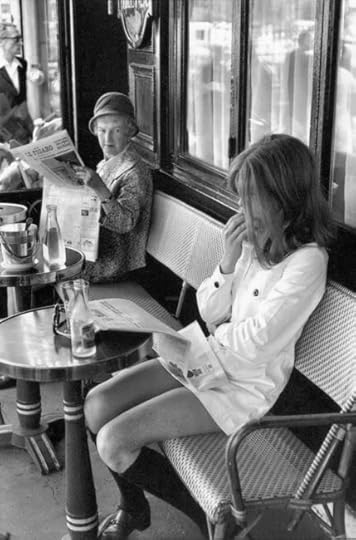
(Henri Cartier-Bresson, Brasserie Lipp)
Would I recommend reading this book? Having read 10 of Modiano'south books now, 'Family record' to me ranks amongst his nigh melancholic and beautiful novels. Some sentences cut right through me:
I was happy. I had no more memory. My amnesia would thicken with each passing day, like a callus. No more by. No more future. Time would halt and everything would alloy into the blueish mist of Lake Geneva. I had reached the country I called 'Switzerland of the center'.
And
Memory itself is corroded by acid, and of all those cries of suffering and horrified faces from the past, only echoes remain, growing fainter and fainter, vague outlines. Switzerland of the eye.
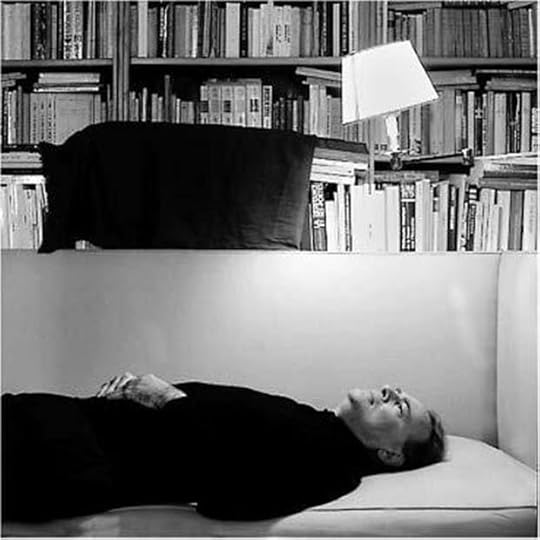
(Patrick Modiano past Olivier Roller)
Information technology is that shattering friction, the discord between Modiano's search for identity and his longing for oblivion that brand some of his novels and then haunting and in a sense boundlessly lamentable, leaving an banner of forlornness that seems to abound deeper by every next novel I read by him.
Many thanks to NetGalley, Yale Academy Printing and the author for giving me the take a chance to read an advanced re-create of Family Record.
...more
Pat
"Nether her ruddy bathrobe, she had a scent that I've sometimes recognized fleetingly on a passerby. At such moments, I relive the bedroom in the gray light of belatedly afternoon, the fluid, prolonged audio of cars on rainy days, her eyes with their glints of mauve, her oral cavity, and the magic of her pale buttocks. When nosotros managed to get upwards earlier, we went for walks in the Bois de Boulogne, by manner of the lakes or the Pre Catelan. Nosotros talked about the time to come. We would get a dog. Perhaps we'd have a trip."Patrick Modiano has this 23 year one-time lover when he is 17 and first trying to become a author. He is disappointed to discover that all the books she buys him are purchased with coin from her rich, Argentinian lover. Okay, so some of the romance surrounding those books is a bit tainted, but he still keeps all the books she gives him and is still thumbing through them many decades later. Knowing Modiano from his work, I can guess that he has wonderful memories attached to each souvenir, regardless of where the money came from to buy them for him. She offers him expensive wearing apparel, and he opts for books instead. Certainly, he is a man after my own heart.
This is an untrustworthy book. The blurbs for it tout that it is a mixture of autobiography and lurid invention. It is, of grade, impossible to separate the two, then in a sense it could be said that Modiano is rewriting or enhancing his life story. He is certainly making the task of his future biographer more difficult. What is truth, and what is complete fabrication? I tin can think of a few moments in my history that I would similar to touch upwardly with a chip of rose colored tint.
I practice hope the 23 twelvemonth old lover who bought him books is truthful.
This is a drove of vignettes that practice not really form a cohesive story. If anything, they add more murkiness to the backstory of Modiano. There are wonderful, insightful observations that attest to his developing skills as a writer. He berates himself at one bespeak for remembering pointless details, just the all-time fiction, in my stance, is rife with seemingly meaningless reflections that actually make a scene come vividly to life.
If you haven't read Patrick Modiano before, this is not a good place to kickoff. I'd read some of his psychological novellas first and circle dorsum to this one later you lot've become amend acquainted with him. And then fifty-fifty though I was oddly discombobulated as I tried to ascertain what was lurid invention and what was some version of the truth, I however enjoyed poking around inside his head on a lazy Saturday afternoon.
Whatever truth is only based on a per centum of fact, and that percentage is a far weep from 100%.
If you wish to meet more of my about recent book and movie reviews, visit http://www.jeffreykeeten.com
I likewise take a Facebook blogger folio at:https://www.facebook.com/JeffreyKeeten

True to Modiano'southward typical plots, his Family Record — published in French in 197
Patrick Modiano is among a small handful of my favorite living novelists. I find his novels, although sometimes cursory, deeply affecting. Modiano is a master of lost and constitute memories, mysterious and unsettled personal and familial histories, and nostalgia for lost urban landscapes. His novels often skitter over decades, moving back and along through time equally memories are recalled and personal histories reconstructed.True to Modiano's typical plots, his Family Record — published in French in 1977 and in English language not until September 2019 — follows a seemingly disjointed and sometimes disruptive chronological arc. Family Records'southward fifteen brief chapters bear on on iii decades of the narrator Patrick's life, told retrospectively from when he was apparently thirty, his married woman virtually xx-5, and parents of a one year old daughter. We know that the October War of 1973 has passed, and nosotros know how important information technology was to Patrick: "That evening, I sensed that something was coming to an cease. My youth? I was certain that zero would ever exist the same, and I can pinpoint the verbal moment when everything changed for me" (p55). As typical with Modiano time lines, the narrator adds complications and confusion: "my retentiveness stretched back before my nascency. I was sure, for instance, that I'd lived in Paris nether the Occupation because I recalled certain individuals from that time, equally well as small, disturbing details that weren't in whatever history book" (p75). And Patrick even speaks of his memories of his married woman and daughter from "another life" from which he "retained a vague recollection and the odd impression that in those days, I had a wife and a niggling girl, the aforementioned ones as today. How could I selection up the traces of that former life?" (p144) In other chapters, the narrator tries to reconstruct his mother's life as an eighteen year old aspiring picture actress in Antwerp, before his birth, and his grandmother'south life in the 1930s.
The fuzziness of Family Record'southward timeline perfectly matches the fuzziness of our asa well as Patrick's memories. The chronological fuzziness also reflects and reinforces the narrator's fuzzy knowledge of his own background: "The fact is, I don't know where I was born or what names my parents using at the time. A navy-blue slice of newspaper, folded in 4, was stapled to this family unit tape: my parents' marriage document. My male parent appears nether an assumed name because the wedding ceremony had taken identify during the Occupation." (pp3-4).
I've now read more than than fifteen of Modiano's novels. Many are superb, and nest in my consciousness and retentiveness in odd and unexpected ways, occasionally making me wonder if the memories are mine or those of his novels' main characters or mine. Other Modiano novels are just excellent, markedly different in tone and structure from those of other contemporary novelists. A very few Modiano novels take been slogs, but always worth the endeavour. Family Tape belongs in the latter category: brief but difficult to follow. In Family unit Record, the usually disruptive Modiano timeframe, which oftentimes only adds to the appeal and interest of a Modiano novel , becomes all the more than disruptive by the addition of episodes and seemingly random characters from Patrick's and his parents' past, likewise as my wondering what'south Modiano's actual Family Record and what's Modiano's richly imagined Family Tape.
For those of you seeking a more comprehensive review, I highly recommend Ilse's.
3.v Modiano stars
...more
Family Tape begins with the narrator trying to register his newborn daughter Zenaide with the metropolis. He meets an onetime friend of his begetter by chance and asks questions of his father who disappeared when he was a kid. but gets petty upon his asking, other than the knowledge that his parent's
This book is similar finding a worn box in an cranium full of sepia-toned photos of life gone by. The individual pictures are just snapshots simply, taken together, speak volumes of life, history, identity, etc.Family Tape begins with the narrator trying to register his newborn daughter Zenaide with the city. He meets an onetime friend of his father by chance and asks questions of his father who disappeared when he was a child. but gets little upon his asking, other than the knowledge that his parent's wedlock was established under false identities. His daughter does become registered - in the nick of time - effectively establishing her identity in the earth. So begins the essential theme of the volume - identity and history.
The rest of the book carries on in vignettes - about his male parent, his grandmother, his mother, himself. Some are, peradventure, based in truth and others are clearly based in fantasy, but near are filled with vibrant characters that come off the page through Modiano's sublime descriptive narrative style.
I can't say that the vignette-like mode didn't get on my nerves at times it did. My encephalon wants a linear narrative and had some trouble adapting to this style throughout. But life isn't ever and so linear (while always beingness linear, if you know what I mean) so, I stuck it through and it worked for me in the finish. Some vignettes were a tad more than boring than others. Nevertheless, Noble prize-winning Modiano is a fantastic writer and it is worth it to take this peek into his creative mind.
Thank yous to NetGalley and Yale University Press for an advance copy in exchange for an honest review.
...more
My granddad wrote most his babyhood in the early 1900s and I inherited his family genealogy records. Decades later I became a genealogy researcher. My father wrote his memoirs of growing upwardly in the D
My childhood was impacted by a move to another state, leaving behind my family unit, friends, and school. I was not the same child later. I did not live in the nowadays for a long fourth dimension. Memories of the past were held dearest; I was awash in nostalgia and longing to restore what I had lost consumed me.My grandad wrote about his babyhood in the early on 1900s and I inherited his family genealogy records. Decades afterward I became a genealogy researcher. My begetter wrote his memoirs of growing upwards in the Depression and WWII years and running a business in the 1950s. Perhaps it was already in my blood to look back and record life. A few years back I wrote about my life on my blog, dipping into my diaries and scrapbooks to rediscover what I had forgotten.
Or misremembered. Somehow, our memories are non truly all fact, there is an element of fiction, rewriting, that happens in our brains. We naturally turn our experience into a novel, a story with significant, a vehicle used to demonstrate the truth as we would accept it.
"Retention itself is corroded by acid, and of all those cries of suffering and horrified faces from the by, only echoes remain, growing fainter and fainter vague outlines." ~from Family Record by Patrick Modiano
French Literature is my weak spot and I had not heard of Pulitzer Prizer winner Patrick Modiano. The encompass and book title, Family Record, defenseless my eye and the blurb cinched my interest in requesting the galley.
Modiano shares his family and personal history through what are substantially short stories, glimpses that skip across time, weaving together a thoughtful consideration of experience.
He tells about returning to the places of his childhood and youth and encountering people who knew his family unit. He records meetings with strangers with mysterious pasts. And of the beautiful woman who pretended to exist the daughter of a in one case-famous entertainer and who asked him to write his biography, setting Modiano on a career path.
He recreates the romantic meeting of his parents in occupied Paris and recalls the uncle who longed to live in the country in an onetime mill. He tells the story of losing himself to the present in Switzerland at twenty years old and seeing the man who collaborated with the Nazis to conduct thousands from French republic, deciding to confront him.
"...And in Paris, the survivors of the camps waited in striped pajamas, below the chandeliers of the Hotel Lutetia. I think all of it."~ from Family unit Record by Patrick Modiano
He begins with the birth of his daughter and the blitz to obtain her birth registration and he ends with his girl in his arms, a beingness however without retention.
It is a lovely read, placidity and thoughtful.
The publisher granted me access to a free egalley through NetGalley in exchange for my fair and unbiased review.
...more
All of the pieces are skillful, about of them are excellent.


Attending! L'écriture peut ne pas plaire à tout le monde.

تحتاج لأن تكون بذهن صاف لتتماسك الأحداث في ذهنك، والا ستتوه أكثر.
القراءة الثانية لموديانو سأحتاج أن اقرأ له أكثر لأفهم السبب الذي استحقت كتبه جائزة نوبل؟

The championship Livret de Famille evokes the theme well; Modiano explores family, identity and memory through these dissimilar episodes. Some of these "memories" are of his parents before he was born; others are perhaps based on real incidents but include a large dose of fantasy (notably the episode at the country estate).
I found it a chip uneven. Some chapters really engaged me; I particularly liked the opening one where he registers his newborn girl's nativity and by chance meets an old friend of his father, the i set in Switzerland, and the penultimate one where he visits the flat overlooking the Seine where he grew up. Others left me indifferent. Probably all-time read in short bursts, a chapter at a time.
...more than
The first Modiano b
In the northern-hemisphere autumn of 2020, in the few weeks we had where the bookshops were open, I walked into the spacious old textile mill at Saltaire and purchased a book entitled Family Tape. An impulse buy. I'd run my fingers downward the volume'south spine, let it fall open in my palms and felt the quality of the thick paper it was printed on. I hadn't heard of the book, simply I'd heard of the author – a Frenchman by the proper name of Modiano Patrick – and I like a nicely printed book.The first Modiano book I read, and savage in love with, was a collection of novellas, published together under the title Suspended Sentences. How I came to own Suspended Sentences or fifty-fifty when I read it is a mystery to me. My copy is a version translated by Mark Polizzotti and printed in 2014 afterwards Modiano won the Nobel Prize in Literature; Family Record has the aforementioned translator, publisher and a like shiny mark of a prize-winning author on the cover. I recall I bought Suspended Sentences in Leeds on some shopping trip that had led me to seek condolement in Waterstones, but it could have been anywhere. I know I had it sitting on my shelf for some time earlier I finally read information technology, and I'd bought it because it was modern and French and therefore like nothing else I was reading, but although I am sure that I have read information technology – an impression remains – I cannot exist sure when. I wrote no review and appear to have recorded information technology on no list.
I took the volume, Family unit Tape, to the till and so that I could pay, and the masked man behind the counter gushed with enthusiasm for my choice. He hadn't read Suspended Sentences – which I recommended to him – simply he had read other books by Modiano and been enthralled.
If you are i of those people who like to be pulled through a novel, dropped from 1 cliff-hanging chapter decisively into the activeness of the adjacent, and then Modiano is not the author for you. If he plots, there remains no prove. Nor does he tie upwardly any loose ends. In fact, he seems to become out of the way to make the threads of his stories fray, their threadbare fabric might exist total of character, merely these characters don't necessarily do anything. I read his work hoping for demystification and close the book mystified equally to how I tin can be so in love with the clarity of his writing and yet endlessly disappointed by its obscurity.
In introducing the novellas of Suspended Sentences, and reflecting on his work translating the stories, Polizzotti states "Generally speaking, and despite the ambiguities in his narrative strategy, Modiano's prose style is straightforward and clear – by which I do not hateful simple – and I accept aimed higher up all to preserve that limpid quality in this translation."
I look at a folio at random and I try to work out what it is that I like so much nearly his writing style. He would be, if 1 were running a writing class, an eloquent instance of the power of varying sentence length. Watch the full stops and you discover short sentences embedded in longer sentences, snuggled in the eye of them, pretending simplicity without ever beingness simple. Just that's not information technology. There are staccato moments, peculiarly perhaps when we're in the mind of a boy who's dealing with what's laid out in front end of him 1 step at a time. It'southward retentiveness, but like when you lot've lost your keyring and you're trying to piece back together where you've been, vocalizing the options, wondering what you could have possibly been doing with your hands that led to the abandonment of the door central. Which surface did you driblet them on?
Then there'south a great repetition held in the verbs. By which I don't hateful that the verbs themselves seem to repeat, they don't. Or well, sometimes they do, just not excessively so. But that verbs are used to build up the scene, give the texture of the scene. They don't tend to be circuitous or flowery verbs. They tend to be quite common verbs. Yet they build up gradually, ane after another, acting to requite weight to a character.
As an example, take a look at these verbs, used in a scene opened at random from the novella Afterimage to draw a human being's movements.
… stationed, waited, crossed, planted (himself), crossed, standing, blocked, turned, post-obit, stopped, folded, stood out, stood, shrugged, strode off…
Suspended Sentences: Three Novellas pg 29-31.
And so I'grand left feeling that although there's something ethereal most the overall design of Modiano's fragments, each individually is weighted and solid. Through some difficult-working verbs, his work grounds itself in the names of people and places, dates and ages, car models and the patterns of wallpaper.
Either way, I've ii more of his books ordered and shipped and I'g hoping they'll be gracing my front door in a twenty-four hours or two.
...more
Highly recommended reading.

The basic themes of the novel -- every bit in Villa Tri
This was the 2nd book in the drove of ten I am currently reading by Modiano. It is a difficult book to read -- it took me almost a week to read 135 large-print pages. It is in an experimental style, and I'grand non sure the experiment was totally successful. Even so, dissimilar many experimental novels of the mid-twentieth century, the fashion was not arbitrarily called; what Modiano is trying to express hither could non exist expressed in any other form.The bones themes of the novel -- as in Villa Triste and, judging by the reviews, most of Modiano'due south piece of work -- are personal identity and memory. It consists of xv separate "episodes", each a few pages long, from unlike stages of the narrator'southward life. They are all written in the first person, and the narrator is occasionally referred to every bit "Patrick" or "Modiano". The problem is not only that they are in no particular order, just that they seem to have no connections; with the partial exception of the penultimate episode,no character except the "I" appears in more than than 1 episode, there are no allusions in any of the stories to anything which happens in whatever other, most of them take place in dissimilar cities and apart from the fact that they are in i "novel" there would be no indication that the "I" represents the same person betwixt any two stories. I use the give-and-take "stories" but in fact none of them is a complete story; they are really just fragmentary memories and all cease inconclusively. Given the brusque length of the episodes, and the fact that Modiano -- similar LeClezio (and the ultimate model for modern French literature, Flaubert) -- favors very detailed descriptions of physical advent, clothing, and surrounding environs, much of each story is spent establishing the setting leaving very petty room for actual events. I found it difficult to become involved in the volume because by the fourth dimension I started to become interested in a story information technology ended and I was back in the setting up of the adjacent episode. I can sympathize with the reviewers on Amazon who abandonned the book equally boring. There is however a sure interest in what he is trying to do; the lack of connection is I recall deliberately calling into question whether retentiveness can really establish a continuous personal identity.
The start episode puts forward the theme; the narrator has a two-solar day old girl Zenaide (the author'south oldest daughter in the photograph essay at the beginning of the drove is named Zina, which is a nickname for Zenaida), and he is trying to become her "ceremonious status" registered at the metropolis hall (what we would call a birth certificate.) On the style, he runs into an old friend of his father purely past risk (chance and coincidence play a big office in about of the stories, but unlike an sometime coincidence-prone Romantic novel the chance element is highlighted rather than taken for granted, as if to say that life is made up of improbable occurences.) The story revolves around the effort to become the nativity registered -- the clerks don't approve the name -- and the narrator's want to learn more than about his father (who disappeared when he was young.) In the cease, the name is registered and at that place is some reflection on the importance of that institution of identity, which the narrator and his parents never had; but the episode ends before we learn if the one-time friend can give the narrator whatever information well-nigh his parents.
I won't effort to summarize the other episodes, only all take some things in mutual -- characters who have unknown pasts, who are living under assumed names, or trying to found or hide who they actually are; searching for physical evidence to verify memories, or alternatively trying to forget them. One interesting thought (also mentioned in Villa Triste) is that the narrator has detailed memories of events in prewar France and under the Occupation, although he was not born until 1945.
...more
In Family Record, Modiano weaves together stories of his complicated and mysterious family unit history. One of the major themes is identity, and the struggle we each face in finding our own. Patrick seems to be Searching for answe
Patrick Modiano was born in France in 1945. He is a French novelist and won the Nobel prize in literature in 2014, Well-nigh of his novels had non been translated into English before winning the Nobel prize. This is my showtime time reading his work, translated by Marking Polizzotti.In Family Record, Modiano weaves together stories of his complicated and mysterious family history. One of the major themes is identity, and the struggle we each face in finding our own. Patrick seems to exist Searching for answers about his family's past. Especially, his father's during the troubled period of the Paris Occupation in WWII. Patrick jumps around from by to nowadays, giving glimpses of his life and the moments that defined him. As well as the mysteries he has yet to figure out. I am left wanting to know more than about his Fathers story and I am left with many questions.
This was a very interesting read, I am looking forward to reading more by this Author.
...more than


Modiano suffered from the lack of attending and intendance from both of his parents as a child. In this book, he mostly tries to explore their past. He specially wants to understand
In « Livret de famille », Modiano reflects on his childhood and young adult memories in 15 different capacity. His memories are not completely presented as an autobiography just as an artistic re-interpretation. Information technology starts with the nascency of his first daughter which makes him question his own personal records and origins.Modiano suffered from the lack of attention and care from both of his parents equally a child. In this book, he mostly tries to explore their past. He particularly wants to empathize what happened with his dad during the Second World State of war. Although his dad was hiding his Jewish origins, he had mysterious jobs that were probably linked with the German language collaborators in occupied French republic.
Virtually of Modiano's stories are endowed with adventure, mystery and fascinating characters. Besides, his mode is quite clear which makes him engaging and easy to read.
...more


Modiano'south books are explorations of his nowadays and time to come life in relationship to his own personal by likewise as the by of his family, his land (French republic) and the place he calls domicile, Paris. These explorations are mysterious and about fantastical. Some of what he tells usa is based upon fact whi
This was, I believe, the fourteenth volume I've read by Patrick Modiano. I take never been so taken with an author'due south writing as I have with this one. He is similar a modern twenty-four hour period minimalist Marcel Proust.Modiano's books are explorations of his present and hereafter life in relationship to his ain personal past besides as the by of his family, his state (French republic) and the place he calls home, Paris. These explorations are mysterious and about fantastical. Some of what he tells us is based upon fact while others are molded into a narrative Modiano creates on his own. His books are non meant to exist historical in nature. Rather, it seems to me that Modiano's reason for writing virtually the things he does is his realization that nosotros cannot live effectively in the present if nosotros exercise not empathize our past. The books he writes are his fashion of trying to gain answers that volition provide an understanding of himself, his relationship to his family, his country and his home boondocks.
Family unit Record is a series of vignettes that tell the stories of Modiano and his family. Time, similar in all his books, is non linear in his presentation of the stories he shares with u.s.a.. We receive some facts, others are omitted. Information technology is this mystery that grabs the reader. The prose is straightforward and captivating in its simplicity. If plot is not that of import to y'all, I highly recommend whatsoever of Patrick Modiano's books to you.
...more than
لست من الأشخاص الذين يهتمون بقراءة المقدمات، ولكنني أوقعت نفسي في حيرة مع هذا الكتاب، الذي بدى لي في لحظة غامضا وفاقدا للتسلسل الزمني، وذلك لأنني تجاهلت المُقدمة.
يستعرض الكاتب صورا من حياته وحياة والديه وذكرياته، يأخذك معه لتعيش تلك اللحظات، التي تكاد تراها، ولا تقرأها فقط بسبب قدر
رواية مؤلفة من خمسة عشر فصلاً وجيزا يمكن قراءتها كما لو كانت قصصا قصيرة مترابطة. هي خمس عشرة لحظة أو خمسة عشر وجها أساسيا تشكل موجز سيرة ذاتية كتبها موديانو مراهنا على الكثافة، وعلى الإيحاء( نص منقول من مقدمة الرواية).لست من الأشخاص الذين يهتمون بقراءة المقدمات، ولكنني أوقعت نفسي في حيرة مع هذا الكتاب، الذي بدى لي في لحظة غامضا وفاقدا للتسلسل الزمني، وذلك لأنني تجاهلت المُقدمة.
يستعرض الكاتب صورا من حياته وحياة والديه وذكرياته، يأخذك معه لتعيش تلك اللحظات، التي تكاد تراها، ولا تقرأها فقط بسبب قدرة المؤلف على الوصف.
...more

Ah ! Adept to have memories. practiced to keep record. Good to have an album to go back periodically.

ليست رواية بل مقتطفات من سيرة ذاتية غير واضحة بالشكل الكافي.
توصيفات عاديّة جدًا لواحدة من أهمّ الحقبات في تاريخ البشرية، وتوثيق غير دقيق لمعاناة شعوب بأسرها.

He is a winner of the 1972 Chiliad prix du roman de fifty'Académie française, and the 1978 Prix Goncourt for his novel "Rue des boutiques obscures".
Modiano'due south parents met in occupied Paris during Earth State of war Ii and began a clandestine relationship. Modiano's childhood took place in a unique atmospher
Patrick Modiano is a French-language author and playwright and winner of the 2014 Nobel Prize in Literature.He is a winner of the 1972 One thousand prix du roman de 50'Académie française, and the 1978 Prix Goncourt for his novel "Rue des boutiques obscures".
Modiano's parents met in occupied Paris during World State of war Ii and began a clandestine relationship. Modiano'southward childhood took place in a unique atmosphere: with an absent father -- of which he heard troubled stories of dealings with the Vichy regime -- and a Flemish-actress mother who frequently toured. His younger brother'south sudden expiry likewise profoundly influenced his writings.
While he was at Henri-Iv lycee, he took geometry lessons from writer Raymond Queneau, who was a friend of Modiano's female parent. He entered the Sorbonne, only did not complete his studies.
Queneau, the writer of "Zazie dans le métro", introduced Modiano to the literary world via a cocktail party given past publishing firm Éditions Gallimard. Modiano published his first novel, "La Place de l'Étoile", with Gallimard in 1968, after having read the manuscript to Raymond Queneau. Starting that year, he did nothing but write.
On September 12, 1970, Modiano married Dominique Zerhfuss. "I have a catastrophic gift of the twenty-four hours of our union. It rained. A real nightmare. Our groomsmen were Queneau, who had mentored Patrick since his adolescence, and Malraux, a friend of my father. They started to argue about Dubuffet, and information technology was like we were watching a tennis friction match! That said, it would have been funny to accept some photos, merely the only person who had a camera forgot to bring a roll of film. At that place is only one photo remaining of us, from behind and nether an umbrella!" (Interview with Elle, half-dozen Oct 2003). From their marriage came 2 girls, Zina (1974) and Marie (1978).
Modiano has mentioned on Oct ix, 2014, during an interview with La Grande Librairie, that one of the books which had a peachy impact on his writing life was 'Le cœur est un chasseur solitaire' (The Heart is a Solitary Hunter), the beginning novel published by Carson McCullers in 1940.
(Standard arabic: باتريك موديانو)
...moreRelated Articles

Welcome back. Just a moment while nosotros sign y'all in to your Goodreads account.


How To Get Registered In The Livret De Famille,
Source: https://www.goodreads.com/book/show/323502.Livret_de_famille
Posted by: blatttheessale.blogspot.com
0 Response to "How To Get Registered In The Livret De Famille"
Post a Comment